





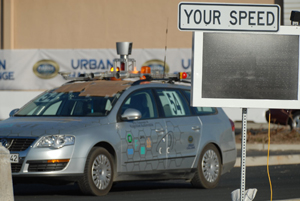
This year's competition really took things to another level in the Urban Challenge where the cars would perform in a real-world like driving environment, complete with roadways, merging, drving through intersections, etc. I had posted about this when it first was described because I started thinking about the implications of where this is all going. That led to the pros and cons of completely autonomous vehicles:
The way I see it, there's a number of overall advantages and disadvantages to cars driving themselves:This year, 3 vehicles successfully completed the Urban Challenge.
Advantages:But it's not all peachy. There's plenty of
- Reduced traffic, especially during rush hour. Can you imagine a world in which there are few or no accidents? And even if there is an accident, you'd never have a stupid "gaper's delay" because drivers of other cars could look at another accident while their car continues to drive itself. Today, people stare at accidents and cause major slowdowns on the highway because they don't maintain their speed when they do so.
- Reduced accidents, and consequently injuries and deaths
- No drunk driving! Your car will take you home. Now getting up once you reached home is another matter.
- Consequence of reduced and more efficient traffic: drastically reduced commute times to going anywhere. Cars on roads with less congestion could travel at very high speeds.
Disadvantages:The more I think about these things, it seems like a scary but inevitable change that's going to occur. Hence the title of this post..."When," not "If."
- For those that enjoy the thrill of driving (including me!), you're always going to be against something taking that away from you. So does that mean that the cars would have to allow you to drive if you want to? But if enough people are choosing to do that, the efficiency of automation is lost and you still have traffic and accidents. Maybe they would allow manual driving only during certain times? But then you're going to have people speeding and driving like crazy because it's the only time they get to.
- Related to enjoying driving, what about roadtrips? A roadtrip wouldn't be a lot of fun if your car is zipping around at 150 or 200MPH (maybe more?) and getting you there in half the time.
- Software glitches. All it takes is one bug in any car's software and the result could be fatal. Not to mention the bug would be on a large group of cars, and this could lead to many accidents. While obviously this kind of software would be very well tested to begin with, a software bug could happen to any company, and in this case the results would be devastating.
- What is the car protecting? When it drives around it is going to avoid collisions. But what happens if you're driving around a narrow mountain pass and another car comes barreling around the corner? Would the car choose to launch you off the mountain because it's programmed to avoid collisions at all costs?
I think I had a pretty good list of implications, and they're still worrisome. Sure all this stuff's still quite a ways off, but this latest challenge helps show it's even closer now than some may like to think.


