





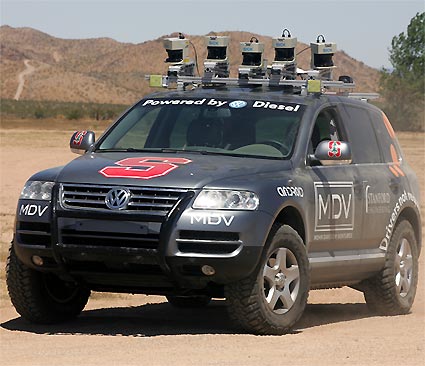
This year, the contest goes to a whole new level as the challenge takes place in an urban environment. From here:
The race is now called the Urban Challenge. Robotic vehicles will need to obey traffic laws, and deal with other vehicles, traffic circles and obstacles on a 60-mile course in less than six hours. The top three teams will win $2 million, $1 million and $500,000 awarded by the government's Defense Advanced Research Projects Agency (DARPA).
About 90 teams have been selected by DARPA to participate, including 11 that are getting financial support from DARPA, and 78 that must rely on private funding. DARPA representatives will visit each team this summer, and those that meet certain standards will participate in a qualifying event in late October. The race will be held at an undisclosed location in the western United States on Nov. 3.
The implications of this contest, as well as the new features that are being implemented in cars right now, are huge. Driving controls are slowly being taken away from the human driver. The very beginnings of it can be seen now with things like the Lexus that can parallel park itself and the cars that warn you when you're either drifting out of your lane or are too close to the car in front of you. In the very near future they've said the car may even hit the brake if it senses an imminent collision.
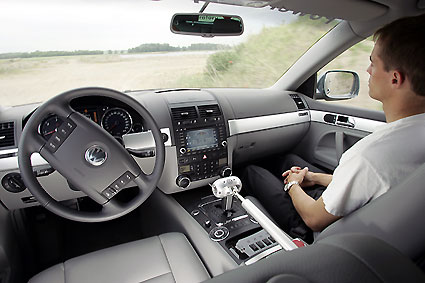
So what happens when you have these new cars come on the road that can drive themselves? They would likely communicate with other similar cars to ensure they handle right-of-way properly and don't collide. But there's bound to be people, at least initially, that don't have such cars. The "smart cars" would need to recognize that and assume that those cars will not operate predictably. Basically, the smart cars need to be smart enough to handle human drivers.
The way I see it, there's a number of overall advantages and disadvantages to cars driving themselves:
Advantages:
- Reduced traffic, especially during rush hour. Can you imagine a world in which there are few or no accidents? And even if there is an accident, you'd never have a stupid "gaper's delay" because drivers of other cars could look at another accident while their car continues to drive itself. Today, people stare at accidents and cause major slowdowns on the highway because they don't maintain their speed when they do so.
- Reduced accidents, and consequently injuries and deaths
- No drunk driving! Your car will take you home. Now getting up once you reached home is another matter.
- Consequence of reduced and more efficient traffic: drastically reduced commute times to going anywhere. Cars on roads with less congestion could travel at very high speeds.
Disadvantages:
- For those that enjoy the thrill of driving (including me!), you're always going to be against something taking that away from you. So does that mean that the cars would have to allow you to drive if you want to? But if enough people are choosing to do that, the efficiency of automation is lost and you still have traffic and accidents. Maybe they would allow manual driving only during certain times? But then you're going to have people speeding and driving like crazy because it's the only time they get to.
- Related to enjoying driving, what about roadtrips? A roadtrip wouldn't be a lot of fun if your car is zipping around at 150 or 200MPH (maybe more?) and getting you there in half the time.
- Software glitches. All it takes is one bug in any car's software and the result could be fatal. Not to mention the bug would be on a large group of cars, and this could lead to many accidents. While obviously this kind of software would be very well tested to begin with, a software bug could happen to any company, and in this case the results would be devastating.
- What is the car protecting? When it drives around it is going to avoid collisions. But what happens if you're driving around a narrow mountain pass and another car comes barreling around the corner? Would the car choose to launch you off the mountain because it's programmed to avoid collisions at all costs?
The more I think about these things, it seems like a scary but inevitable change that's going to occur. Hence the title of this post..."When," not "If."


