




Read on for more info and some pictures.Participants ranging from souped-up SUVs to military behemoths will be graded on how well they can self-drive on rough road, make sharp turns and avoid obstacles -- hay bales, trash cans, wrecked cars -- while relying on GPS navigation and sensors, radar, lasers and cameras that feed information to computers.
The competition is part of the Pentagon's efforts to have a third of the military's ground vehicles unmanned by 2015 to fulfill a congressional mandate.
This year's race will cover about 150 miles of desert and mountainous terrain looping to and from Primm, Nevada. While the exact route is kept secret until hours before the race, vehicles can expect to drive over rough desert roads, maneuver mountain trails and pass dry lake beds.
The first vehicle to traverse the entire course in less than 10 hours wins. If no one finishes -- a possible outcome -- DARPA may sponsor another competition.
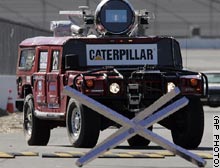
Last year's inaugural race in the Mojave Desert ended without a winner when all the entrants broke down before the finish line. The best performer was a converted Humvee built by Carnegie Mellon University, which traveled only 7 1/2 miles before having engine trouble.
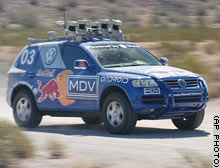
Of the 16 vehicles that ran the course, seven finished. During last year's semifinals, no vehicle completed the course in the first day. Eventually, only seven entrants completed a flat, 1.4-mile obstacle course. But eight others that failed were allowed to advance. Organizers expect most vehicles this year to finish the qualifying course.
DARPA officials and team leaders contend that this year's field is far more competitive. Some vehicles already have driven hundreds of continuous miles in the Southwest desert during practice runs, including several that tested on last year's race course.
The semifinalists, from more than a dozen U.S. states and Canada, were selected from a pool of about 200 entrants, which doubled from last year. They include a mix of computer programmers, mechanical engineers, college students, hot-rodders and off-road enthusiasts. Many teams are backed by corporate sponsors.


