




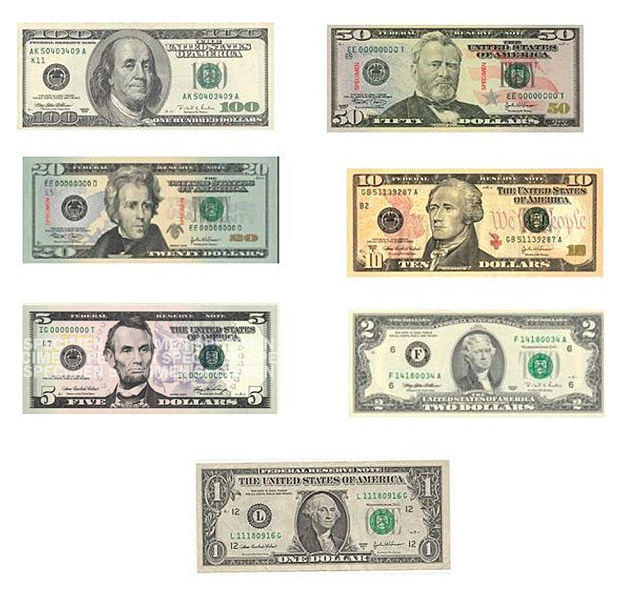
A sensible approach would be something like the Euro, which has plenty of features to help those with poor or no vision.

Euro banknotes increase in size with increasing denominations, which helps both the visually impaired and the blind. The predominant colouring of the notes alternates between "warm" and "cool" hues in adjacent denominations (see the chart above), making it still harder to confuse two similar denominations for those who can see the colour. The printing of the denominations is intaglio printing, which allows the ink to be felt by sensitive fingers, allowing some people to distinguish the printed denominations by touch alone. Lower denominations (5, 10, 20) have smooth bands along one side of the note containing holograms; higher denominations have smooth, square patches with holograms. Finally, the €200 and €500 notes have distinctive tactile patterns along the edges of the notes: the €200 note has vertical lines running from the bottom centre to the right-hand corner, and the €500 note has diagonal lines running down the right-hand edge.
Although there have been other currencies pre-dating the euro that were specifically designed in similar ways (different sizes, colours, and ridges) to aid the visually impaired, the introduction of the euro constitutes the first time that authorities have consulted associations representing the blind before, rather than after, the release of the currency.


