
You are viewing a read-only archive of the site that used to be symbii.com, which was active from 2005–2013
Bogey Central Easter Egg
niraj.com
A Niraj
Sanghvi
Website


Something You Might Be Interested In
A collection of funny, interesting, and crazy stories you might be interested in
   
US is slow to implement 2D mobile barcodes Cell Phones
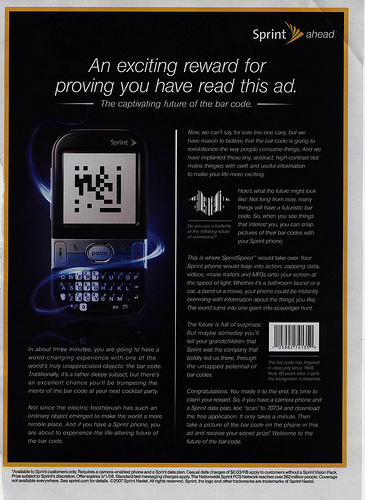
About two months ago, Sprint had an ad in Wired magazine (pictured below) that talked about how things may soon get barcodes printed on them so you could scan them with a mobile device. For instance, a barcode on a movie poster could be scanned on your phone, and it would lead you to a website with showtimes. Or an ad for a music album could have a barcode that leads you to a free MP3 download.


The ad led Sprint users to text "scan" to 70734 to get a program called Scanlife that allows such interaction. The ad also contained a barcode which led to a page with some free ringtones. Some phones require you to take a picture of the barcode, which then gets interpreted. Other phones let you simply move the camera over the barcode and as soon as it is recognized (in real-time), the phone beeps and takes the appropriate action.

Scanlife uses their own format, EZcodes, though they also recognize several other popular formats. Depending on the format, many support more than just linking to websites such as storing contact information, SMS and text information, calendar info, call a phone number (no need to dial), etc. For instance you could put a code containing contact information onto your business card, and now someone can easily add all your information to their phone.

Apparently QR codes have become the most popular format in Japan, and they started printing the codes on all sorts of things since at least 2005. Here's the results of a survey that was done in Japan about how often people use QR codes and what for.

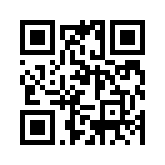
And of course, I've created a QR Code for symbii.com which I've put in the footer of the page (also pictured below):

Submitted by niraj  |  21 comments

More Stories

To reply to a specific comment, find it below.
  • [Untitled]
    Posted by: dave on Feb 26th, 2008 | 12:12pm

    So what is someone supposed to do with the Symbii QR code?

    • [Untitled]
      Posted by: niraj on Feb 26th, 2008 | 12:52pm

      Well, putting it in the footer mainly benefits me...if I'm going to step away from the computer I can load the site on my phone if I'm working on some feature. (Symbii mobile perhaps??? :)

      But really they're not that useful on the web, since that's where they're meant to lead you from physical places in order to provide more information that's relevant to different objects.

      They say they can do all kinds of things, but I'm sure web links are the most useful, and contact information would be a distant second use. Everything else doesn't seem too logical (i.e. SMS).

  • Why will the Scanlife program not work in the U.S.?
    Posted by: Anonymous on Feb 26th, 2008 | 7:58pm

    FYI, with the Scanlife program consumers/web users cannot click on QR codes in the United Stated. Scanbuy is currently in litigation with a company called Neomedia Technologies. Scanbuy has a cease and decist order preventing their platform from working with these types of codes.

    However, consumers/web users can click on QR, data matrix, Maxi, and Aztec codes with the Neoreader. Users can download it at http://www.neoreader.com

    They will be able to create their own codes if they so desire. The Neoreader will not be able to read proprietary codes like the EZcode. Proprietary codes need their own software to decode them.

    Bena Roberts blog covers information about the use of these types of codes.

    One last thing, when Sprint released the Phone IQ it had an Aztec code spinning in space in the back ground. The Scanlife platform cannot read the Aztec code. Users will be able to click it with the Neoreader where the link will take them to the NY Times article regarding the MC2 Steering Group working on mobile standards of these codes.

    Ironic?


  • dlethe01
    Posted by: Anonymous on Feb 27th, 2008 | 1:14am

    Can I scan other codes with ScanLife besides EZcodes?
    Inside the U.S. you can scan EZcodes. Please see the international capabilities here.
    http://www.scanlife.com/help.html

  • Scanlife codes work just fine for me
    Posted by: Anonymous on Feb 27th, 2008 | 10:15pm

    Scanlife codes work just fine for me. I am not sure what you mean by a cease and desist, from what I read, the parties agreed to put their suite and counter-suits aside until the end of the year until the patnent office reviews Neomedia's patents. The EFF has requested review of all Neomedia's patents and from what I hear they will be invalidated.

    • WRONG
      Posted by: Anonymous on Feb 28th, 2008 | 2:59pm

      The EFF requested the review of only 1 NeoMedia patent.

      NeoMedia Technologies has a suite of twelve issued patents covering the core concepts behind linking the physical world to the electronic world.

      Scanbuy uses the indirect encoding method for their barcode resolution process.

      Indirect encoding (patented by NeoMedia) is the process of linking the target information to an index (364528 for example) and putting that unique identifier into a 1D UPC/EAN barcode. The code reader on the mobile phone reads the barcode and sends the code data over the Internet to a central resolution server that will tell the mobile phone what action is associated with the index, i.e. access a URL, download media, initiate a phone call, ect.

      • [Untitled]
        Posted by: niraj on Feb 28th, 2008 | 4:21pm

        Whatever the case may be, I can currently scan QR Codes in the US using the ScanBuy/ScanLife software.

        Hopefully the matter gets resolved and they can continue using QR Codes, because it would be stupid for them to introduce yet another format (EZCodes) as that will only slow adoption in general.

      • Wrong again
        Posted by: Anonymous on Feb 29th, 2008 | 12:43pm

        The one patent that the USPTO has determined there are substantial new claims of patentability on, is Neomedias core patent. The other 11 patents are all based off of this core patent in one form or the other. So if the core patent is deemed unpatentable by the USPTO, the other 11 patents are pretty much worthless.

        BTW I like your little copy and paste from blog to blog on what Neoms process is, or should i call it spam from blog to blog.

        I also like how you go from one user name to another to attempt to convince others there are multiple posters offering the same or similar opinions.

        Nice little plug on GOMO news as well, but that site is far from the best site to go to to obtain bar code usage information. But wait since they appear to be backing Neomedia, then i guess that makes them the expert on the subject....NOT.

        • NeoReader
          Posted by: Anonymous on Feb 29th, 2008 | 1:04pm

          Based off the award winning Lavasphere technology developed in Germany by Gavitec, the NeoReader features NeoMedia's patented resolution technology combined with Gavitec's ultra-small footprint and platform independent algorithms. It is able to read and decipher all common non-proprietary 2D codes (Data Matrix, QR, Aztec, Maxi) as well as URL embedded 2D codes and all 1D UPC/EAN/Code 128 open source codes. The NeoReader supports direct and indirect code linking, which guarantees maximum interoperability with already existing platforms like 2D Data Matrix Semacodes, and Japanese QR links. This allows the user to click on a variety of codes with a single application installed on their mobile device.

          The NeoReader ushers in and inaugurates a brand new era of innovative mobile enterprise and optical code reading solutions for the wireless industry. Visit get.neoreader.com to download the free application, and instantly transform your mobile phone into a universal code reader.

        • I Am Right
          Posted by: Anonymous on Feb 29th, 2008 | 1:28pm

          NeoMedia has 4 core patents - The Hudetz and the Durst patents.

          I suppose the 4 patents NeoMedia purchased from Loyalty Point will also be deemed worthless?

          LOL ... Too Funny

          • Bena Roberts
            Posted by: Anonymous on Mar 1st, 2008 | 1:38am

            Hi, I am the publisher at GoMo News.
            (www.gomonews.com) We focus on mobile search, mobile advertising and mobile barcodes. We are a business to business blog - essentially.

            Thanks for the mentions but GoMo News is 100% independent. If companies buy ad space that is great.

            There is a lot of misunderstanding relating to barcodes and we are trying to get ALL points across.
            Operators loves exclusiveness (that is always the case)
            Vendors generally want to make money
            Consumers need understanding and suppport and this means one common standard, one common reader and one common form of using mobile barcodes.

            isymbii - great blog - glad I found you!
            Bena

        • No, it is "YOU" who is "wrong again"
          Posted by: Anonymous on Mar 1st, 2008 | 2:02pm

          Your statement contained in "Wrong Again" posted Fri, Feb 29th, 11:43am,
          claiming that ANY decision by the USPTO would affect all 12 NeoMedia patents is wrong!

          NeoMedia acquired some very valuable patents from BarPoint/LoyaltyPoint in the past, which are totally separate from the ONE patent being reviewed by the USPTO at this time. No decision by the USPTO would affect those separate patents. Also, the ex-parte re-exam process provides for the patent holder to respond, if appropriate, to the USPTO decision - and the filer rrequesting said appeal, is SHUT OUT from any further participation.

          I hope you weren't trying to deceive the symbii blog readers, and were just misinformed or unaware of the facts.

          • What a Joke
            Posted by: Anonymous on Mar 1st, 2008 | 2:22pm

            If the initial process is deemed to be non-patentable, does Neomedia have any other system in place that uses any of the patents and prohibits any one else from developing their own system of bar code reading?

            Please enlighten us on what Neomedia is doing with the 4 patents from loyalty Point, and how that effects someone like Scanbuy, if Neomedia's core patent is over turned in full.

            My point was, all 12 of their patents will have no effect on the competition for bar code reading, if the core patent is over turned.

            It will also have a profound on their own operations, because then they certainly will not be the front runner in this space. Their application as of right now is in use by no one, and without that core patent, and the revenue it might bring from others, they are in very deep trouble as a going concern. That is a fact.

            What is your point about the filer being able to respond to USPTO? So what? If they USPTO says the patents are no longer valid, a response and appeal by the company is not likely to change that. It does not matter if the party requesting re-exam has the opportunity to respond or not. Its all in the hands of the USPTO now, even though Neomedia gets to respond as you put it.

            • Happy To Prove You Wrong Again
              Posted by: Anonymous on Mar 1st, 2008 | 4:02pm

              NeoMedia has 4 core patents - 2 Hudetz patents and 2 Durst patents.

              Hudetz - 5,933,829 & 6,199,048
              Durst - 5,933,829 & 6,108,656

              The Hudetz patent (6,199,048) currently under review by the USPTO was filed in 1999 and granted in 2001.

              NeoMedia has 3 core patents (5,933,829 - 5,933,829 - 6,108,656) that pre-date the Hudetz patent (6,199,048) currently under review by the USPTO.

              Patents (5,933,829 - 5,933,829 - 6,108,656) were granted in 2000, which pre-dates the Hudetz patent (6,199,048) which was granted in 2001.

              If every claim in the Hudetz patent (6,199,048) currently under review by the USPTO is deemed unpatentable, NeoMedia still has 3 other core patents, which pre-date the Hudetz patent that they can operate and derive revenue and licensing fees under.

              • Hi Streetstylz
                Posted by: brewskih on Mar 3rd, 2008 | 10:08am

                Your assertion is flawed by one thing.
                For the record, although we had this discussion, years ago, before you ever became a shareholder in Neomedia, the patent in question is an extension of the original core patent filed in 1995. That application was filed in 1995 and the patent awarded in 1999. At that time Neom filed what is known as a modification of the patent, and a debate ensued as to whether the patent date changes to 1999 or stays 1995. The outcome of that debate based on the USPTO rules, was that the original date of 1995 stays for the purpose of expiration etc.

                If you do a little history of the patent being reexamined, it shows its a member of the 1995 patent family, which was awarded in 1999.

                So if this patent is considered not valid by the USPTO, it calls into question the parent patent it was based off, and Neomedias very first patent covering this technology.

                Its funny how in the past, you and the group you post with, have opined this patent was crucial to Neomedia going forward, and now you seem to be saying the outcome of this patent doesn’t matter, because Neomedia has prior patents?

                Simply stated patent number 6,199,048, filed in 1999 is a division of patent number 5,978,773 filed in 1995, as it states in the application.

                Even Neomedia seems to think the outcome of the USPTO action is relevant to the Scanbuy case, and thus the reason they stayed their case against Scanbuy, PENDING THE DECISION BY THE USPTO.

                Here is a little background info showing the parent patent number, and following that the link to the parent patent, filed in 1995 and awarded in 1999.

                Description Parent Number Parent Filing or 371(c) Date Parent Status Patent Number

                is a Division of 08/538,365 10-03-1995 Patented 5,978,773

                Application Number: 08/538,365 Customer Number: -
                Filing or 371 (c) Date: 10-03-1995 Status: Patented Case
                Application Type: Utility Status Date: 10-21-1999
                Examiner Name: PAN, DANIEL H Location: What is a Location? FILE REPOSITORY (FRANCONIA)
                Group Art Unit: 2183 Location Date: 07-12-2007
                Confirmation Number: 6434 Earliest Publication No: -
                Attorney Docket Number: 75353-00006 Earliest Publication Date: -
                Class / Subclass: 705/023 Patent Number: 5,978,773
                First Named Inventor: FRANK C. HUDETZ , LISLE, IL (US) Issue Date of Patent: 11-02-1999

                http://tinyurl.com/ysnl4q

            • Hmm
              Posted by: Anonymous on Mar 1st, 2008 | 7:15pm

              You should really do some due diligence on this whole process, including statistics on how often the USPTO upholds the patents, including after the patent holder responds.
              :-)
              Good luck to you. I can read in your response that you are circumventing those facts.

              • Maybe I can help on this issue
                Posted by: brewskih on Mar 3rd, 2008 | 3:36pm

                The best estimates available, show that about 76 percent of ex-parte re-exams experience significant changes, This is surprising, considering the process favors the patent holder as has been mentioned previously, and the petitioner only gets one chance to offer their arguement.

                Just as surprising is the claim some have tried to make, that the USPTO frowns on re-exam requests, because it suggests they made a mistake earlier when they granted the patent. Sound reasoning suggests that if they require modification on 76 percent of the re-exams then they tend to agree with the requester that they indeed did err in a majority of the cases.

                Of those 76 percent that are modified, 64 percent wind up with the cancellation of some of the claims, and the other 12 percent result in the entire patent being reversed as unpatentable.

                On the appeals side after all this has transpired, 50 percent of the time the USPTO decision is upheld in its entirety, and the other 50 percent of the time the patent office decision is modified. What modified means is anyones guess, because it does not state what that means.

                So lets use some numbers to get an idea of the impact. Lets assume the patent office rules on 100 re-exams in one year. 12 of those patents will be thrown out in their entirety. 24 of those patents survive with no changes what-so-ever. The remaining 64 patents have some of their claims cancelled.

                Of course on appeal, the 24 that went unchanged are not included, because the requester has no right to appeal, and the patent owner is not going to appeal a favorable ruling in their favor. So on appeal, we are looking at 76 patents perhaps(I doubt that every patent owner will appeal). Of those 36 stay as ruled upon initially. The other 36 get modified by the appeals board in some manner. Maybe they reinstitute one claim, but let stand the USPTO ruling on other claims, who knows.

                So the final out come if you do the math, at least 48 percent(12 that were thrown out initially, plus the 36 that go through the appeal process with no changes to USPTO decision) go through significant changes if not outright rejection.

                These numbers really mean nothing, since we don't have statistics showing what the appeals board modifies compared to the USPTO conclusion. They also mean nothing since in many cases, its the patent owner requesting the ex-parte re-exam, just to validate their patents in a friendly process as opposed to a hostile process. So if there is not a third party involved that is bringing to the USPTO prior art, they more then likely wont be looking for it, as they didnt when they awarded the patent to begin with.

                I would be willing to bet the majority of the 24 that go through unscathed are the patent owners own re-exam requests, but again we have no statistics so thats just a guess on my part.

  • One common standard
    Posted by: Anonymous on Mar 1st, 2008 | 11:06am

    "Consumers need understanding and suppport and this means one common standard, one common reader and one common form of using mobile barcodes."

    This is an interesting comment, from a business to business blog editor. Is there only one common software application used for anything in the electronic technology class? Windows versus Linux, Microsoft Office versus open Office, G-mail versus Outlook. The list goes on and on, and in many cases involves many more then the two examples listed.

    The software application for barcode reading will follow the same path, and the consumer will choose which one they prefer.

    On the one common standard comment, that too will not be the case. What works for one market, may not work for another. Lets look at an example everyone may be familiar with, such as the automotive technology. There was not one global standard for a very long time. At one time, not long ago, Europeans were still using leaded fuel, while all American automobiles had to use unleaded. The glass used in models for use in Europe, was of a different standard then allowed on those to be shipped to the US, so the car had to be ordered for US shipping special.

    Standards are typically established by country or region, based on their needs, and over time, the multiple standards are merged globally.

    However, the lack of one of this or one of that, or the lack of one standard, or multiple standards, has never prevented the user or consumer from adapting the technology.

    But in the end, if it does eventually come down to one standard, one reader and one common form of use, then I think the Asian market would be the leader in determining what those criteria will be. Since they were first to market, with the only code that contains the characters necessary for their alphabet, and are years ahead of the rest of the world towards total adaption by the consumer.

    The lack of mass adaption by consumers, at this point, has nothing to do with the number of codes, then number of standards, or the number of reader applications. In all the results I have seen published thus far, when the consumer has been exposed to the technology through any type of trial or campaign, they have been quick to understand and just as quick to adapt the new technology. The problem right now is that there are not enough campaigns in effect, to make the consumer even aware the technology exists. Outside these forums, where the average poster has been following this technology for years, the rest of the world is clueless that these technologies are even possible. Even in forums such as these where the average participant is far more educated then the general public, there is a large percentage, who did not even know the technology was in widespread use in Japan, until just recently.

    For the record, a perfect example of how one standard or one application has no real impact, is the mobile phone itself. Here in the US there is not one standard. There is not one application. But the mobile phone took off like wild fire, even though if you wish to change carriers, you more then likely have to purchase a new mobile phone, that will work on the new carriers network.