





Basketball vests (singlets) with electroluminescent displays that show a player's score, and number of fouls, are being trialled in Australia. The vests can also display more general information, like the amount of time left in a game. This gives players greater confidence in their team's tactics, say the researchers involved.
The simple, coloured display panels are attached to each vest and connected to a small computer, about the size of an iPod, strapped to each player's body. These computers communicate wirelessly with a central control system, installed at the side of the court, which keeps track of all relevant statistics as the game goes on.
"Team sports uniforms already communicate information visually," like a player's name, says Mitchell Page, who developed the system at the University of Sydney. "We wanted to augment the existing team sports uniform model to communicate more relevant information, such as a player’s stats and performance."
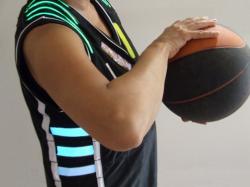
The uniform does look a little weird...
Luminescent bars running up the side of a vest indicate the points scored by each player, while lines on their shoulders show the number of fouls against them. Panels on each player's chest indicate when the game time or shot clock is running low, and panels on their back show which team is winning.Apparently they picked basketball since "player-specific information changes rapidly during the sport and because no physical contact is involved." But basketball has a fair amount of contact both with other players and with the floor, so the lack of physical contact isn't that great. Now they're also looking at changing the system to be built into the vest, rather than having to strap on some unit.
"Results were extremely positive," Page told New Scientist. "We found that spectators benefited the most – understanding and even enjoying the game a whole lot more than usual." He adds that players also enjoyed wearing the displays, using them to judge when to play aggressively or more conservatively. "They used the time limit displays to gauge when to pick up the pace of the game," Page says.


