There's a cool article over at CNNMoney about how an airline company in Ireland is predicting in a few years flights will be free. While it seems far-fetched, Ryanair already provides free flights to about 1/4 of their current customers.
How do they pull this off? With a combination of agressive cost-cutting and additional revenue streams. On the cost-cutting side, they do things like remove back-of-the-seat pockets, don't have free peanuts, etc. Every cent saved counts. On the additional revenue side, they charge for everything. In essence you flight isn't cheap because they charge for things like bag check-ins, drinks and food in-flight, and more. But they earn additional revenue through advertising on the seats and deals with hotels and rental car companies that give them a cut for referrals. That revenue is esentially subsidizing your flight.
In all your flight isn't truly free, but it's pretty damn cheap. If you're not looking for frills, it's certainly worthwile.
kirat submitted his first story! In a study sure to incite controversy, a study failed to show the power of prayer, according to a Reuters article.
A study of more than 1,800 patients who underwent heart bypass surgery has failed to show that prayers specially organized for their recovery had any impact, researchers said Thursday.
In fact, the study found some of the patients who knew they were being prayed for did worse than others who were only told they might be prayed for -- though those who did the study said they could not explain why.
The patients in the study at six U.S. hospitals included 604 who were actually prayed for after being told they might or might not be; another 597 patients who were not prayed for after being told they might or might not be; and a group of 601 who were prayed for and told they would be the subject of such prayer.
The praying was done by members of three Christian groups in monasteries and elsewhere -- two Catholic and one Protestant -- who were given written prayers and the first name and initial of the last name of the prayer subjects. The prayers started on the eve of or day of surgery and lasted for two weeks.
Among the first group -- who were prayed for but only told they might be -- 52 percent had post-surgical complications compared to 51 percent in the second group, the ones who were not prayed for though told they might be. In the third group, who knew they were being prayed for, 59 percent had complications.
After 30 days, however, the death rates and incidence of major complications was about the same across all three groups, said the study published in the American Heart Journal.
"Our study was never intended to address the existence of God or the presence or absence of intelligent design in the universe" or to compare the efficacy of one prayer form over another, said the Rev. Dean Marek, director of chaplain services at the Mayo Clinic, one of the authors.
Apparently at the end of the report, they said this does not challenge the idea of family prayers, as the people praying were not connected (as family or friends) with the people they were praying for.
Submitted by Kirat
|
Click for 2 comments
I decided to investigate why so many hits in the last few days came from a Chad Johnson story I posted in December. Looks like just a few days back, the NFL's competition committee decided they want to crack down on the touchdown celebrations that the fans love.
The league periodically gets tough on end zone fun and games, which would be just swell if we were living in, say, 1966. But it's 2006, and that whole "just do your job and go sit down" ship has long ago sailed. It's a new day, a day in which players spend as much time working on their next post-TD routine as they do on their pass routes. They do the Worm after scoring a touchdown, or they climb the goal posts like they're Spiderman, or they lay the ball on the ground and pretend to give it CPR, and guess what? The world doesn't end.
That's not to say that all the showing off in the end zone is an improvement over the old days, just that there's no sense in fighting it. It is, as they say, what it is. The old-school coaches and executives trying to nudge the league back toward its more stoic, reserved days are like the parents who were aghast at the swivel of Elvis' hips 50 years ago -- hopelessly behind the times and powerless to stop it.
The danger of all the end zone silliness used to be that it would enrage the beaten opponent, who would retaliate, and violence would ensue. But these days no one gets mad, with the rare exception, such as Owens' desecration of the Dallas Cowboys' star a few years ago. Strutting and preening are an accepted part of the athletes' culture now. The defensive back who is embarrassed by a receiver's end zone routine one minute will be showing off his own choreography after an interception the next. If the athletes can handle it, why can't the rest of us?
The players laugh, the fans laugh, but a few stuffed shirts see a sign of the apocalypse. They determine to rein in all this foolishness, even though it hurts absolutely no one. "Individual celebration was getting out of hand," said Tennessee Titans coach Jeff Fisher, the head of the competition committee. "The players' association was unanimous in wanting to get this under control."
Really? There are certainly a few wide receivers who aren't down with the program. One of them is Johnson, who vows that any new restrictions won't significantly affect his routines. "Of course you cannot stop someone as creative as me," he said. "How can this bother someone as creative as me?"
Whether what Johnson does is art or ego is a matter of opinion. But one thing creativity and egomania have in common is that they're both hard to rein in once they've been allowed to flourish for a while. The league is fighting a losing battle. The old-school hard-liners need to realize that times have changed and their desperate attempts to change them back are too little, too late. They might as well relax a bit and let the new breed have its fun.
I'm glad to see that Chad Johnson is not willing to let any new rules curtail his TD shenanigans.
Wed, Mar 29th, 2006 | 10:40pm | Food
dave submitted a story in the Kansas City Star about the possibility of healthier bacon. Using genetic engineering, pigs were produced with more healthy fat.
Scientists using genetic engineering techniques have produced pigs rich in omega-3 fatty acids -- a kind of healthy fat abundant in fish but not naturally found in other meat.
The omega-3 fatty acids are believed to offer some protection against heart attacks, and federal nutrition guidelines recommend that adults include them in daily diets.
But "some people are not going to eat fish no matter what," said Penny Kris-Etherton, a professor of nutrition at Pennsylvania State University who was not involved in the research. "This is a way people who don't like fish can benefit."
One little question looms over the potential feast of greasy bacon, succulent chorizo and juicy Chinese pork stew. The research is in its early stages, and no one has yet tried the pigs to see if they taste like pork. Harvard University's Jing Kang, one of the scientists involved in the experiment, is confident the levels of omega-3 fatty acids in the new pigs aren't high enough to ruin the flavor.
The new pigs could help pork producers solve a tricky problem. Through breeding and diet changes, farmers have dramatically lowered pork's fat content in the last 30 years. But leaner meat is drier and less flavorful.
To improve the taste and texture, farmers are now trying to increase the amount of fat in pigs without drastically raising saturated fat -- unhealthy fat that can boost cholesterol, which in turn can lead to heart disease.
Kang, meanwhile, is looking at new culinary possibilities. "Pig was the first," he said. "But transgenic chickens, cows and fish are on the way, too."
There's something freakish about genetically altered food, no matter how positive the benefits seem. Maybe it's a good thing the FDA is not approving any genetically modified food yet. It be hard to gauge any long-term adverse effects that could be present.
Submitted by dave
|
Click for 1 comment
dave submitted an interesting article on the growing trend of celebrity voiceovers.
"Bright. Crisp. Clean. Pure," says the silky smooth, perfectly masculine voice on the beer commercial. "This is Budweiser. This is beer." Quick, who is that? Hint: It's a big movie star. Though his name's never mentioned, the makers of Budweiser are banking on the fact that you'll get it eventually - and that you'll say "Wow!" when you do.
Twenty years ago, voice-overs were the domain of the baritone radio announcer or the character actor. No longer. These days, more A-list stars than you might imagine are cashing in.
Kevin Spacey's pitching Honda. Kelsey Grammer does Disney. Kiefer Sutherland voices Apple commercials, and his dad, Donald, did Volvo. There's Queen Latifah (Pizza Hut), Sean Connery (Level 3 Communications), Christian Slater (Panasonic), Gene Hackman (Oppenheimer Funds) - oh, and then there's Julia Roberts. That's right, Julia Roberts, in a recent campaign for America Online.
"Honestly, sometimes I'm mystified," says Maureen Kelly, a casting director who has worked in the voice-over field for two decades. "I guarantee you most people couldn't tell the AOL voice was Julia Roberts. I'm just not sure why advertisers spend this astronomical amount of money when the voice isn't even identifiable."
By astronomical, we're talking seven figures, easy. Although companies won't say how much they pay, industry experts say a megastar like Roberts would have to make well into that range.
Or George Clooney, that mysterious Budweiser voice. When Anheuser-Busch was searching for "a classic voice" last year, the company hit on Clooney as the perfect embodiment of its product. "George Clooney - it's almost a brand in itself," says Dan McHugh, vice president for trademark brands. "It just made a lot of sense for us."
The idea, says McHugh, is that the consumer will "sort of know the voice. They may not necessarily place it right away, but when they do, they say, 'Wow' "! It's that whole intrigue of discovery." In other words, the "cool" factor is higher because there's mystery involved.
I find that last part about the "mystery" especially true. I've been thinking a lot ever since I heard a Jameson Whiskey radio ad because it sounds mostly like Steve Carell, though at times it also sounds like it could be Stephen Colbert or even Mo Rocca. But figuring it out made me pay more attention to it, and that's the real goal.
Wed, Mar 29th, 2006 | 12:47pm | Bananas!
How bored are you? dave submitted a story about a college student who tried to spend an entire week in a Wal-Mart during his spring break.
Bartels, 20, an aspiring writer and Drake University sophomore, thought he'd spend a week in a Wal-Mart as a test of endurance, using it as the premise for a magazine article. His college adviser liked the idea.
"I just intuitively thought, 'This is brilliant!"' said Carol Spaulding-Kruse, an associate professor of English. "I wasn't quite sure why, but it just sounded like a really good idea."
For 41 hours, Bartels wandered the aisles of a Wal-Mart Supercenter in Windsor Heights that's open 24 hours a day. He checked out shoppers, read magazines, watched movies on the DVD display and played video games.
He bought meals at the in-store Subway sandwich shop, but was able to catch only brief naps in a restroom stall or on lawn chairs in the garden department.
A shift manager approached him and asked him if he was finding everything he needed. "He said, 'Didn't I see you over by the magazines, like, five hours ago?' I told him, 'Maybe,"' Bartels said.
Then, The Des Moines Register, which had been contacted by Spaulding-Kruse, called to ask him about the experience. Once the story ran, TV networks began calling. He also talked with a book agent, has been contacted by New Line Cinema about a movie concept and did a radio interview with National Public Radio.
Bartels told The Associated Press he has decided the stunt wasn't such a failure after all. "I'm incredibly happy with the press coverage," he said. "It would be kind of silly not to accept it with open arms."
This is like something someone in Carbondale would do (*cough*Mark*cough*). Somehow, I don't think it was the intent of Spring Break though.
Submitted by dave
|
Click for 1 comment
Wed, Mar 29th, 2006 | 8:23am | Food
The number of cola combinations has quickly grown. There's the usual regular or diet, and then the more recent variations like lime, cherry, vanilla, caffeine-free, and a million others. The list doesn't apply to just cola either, as evidenced by Diet Cherry Vanilla Dr. Pepper. But what if you want to experiment with flavors, or select something based on whatever your taste is at any given moment? A company called Ipifini has your solution. Their "programmable liquid container" product allows you to select your combination of flavors, colors, and amount of caffeine in your beverage just before you drink it, but after you purchase the product. How? Little buttons that contain the additives are located on the surface of the bottle, so you can add just the ones you want. The buttons could contain flavors, colors, and/or caffeine.
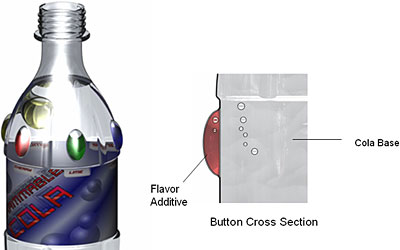
From Ipifini's site:
For example, a programmable cola bottle with buttons for lemon, lime, vanilla, and cherry flavors as well as a caffeine button allows for 32 combinations of soda. A programmable paint container with 20 pigment additive buttons allows the consumer to select from one million paint colors. The technology is described in a robust patent application filed by IPIFINI.
Sounds pretty awesome, though it'll be interesting to see if the additives really mix as well as they would have if they were added in processing. If this works as expected, I think these bottles will really take off very quickly as it is a simplification for companies in both processing and brand marketing, and it gives the consumers a lot of choice.
Update: IPIFINI has provided me with a video of their bottle in action. You can see how the button causes the additive to shoot into the drink. It may take a second to load, as the video is 5MB.
Submitted by niraj
|
Click for 14 comments
The rumors can be put to rest. Reportedly (by several sources), show creator Mitch Hurwitz has left negotiations for getting Arrested Development picked up by Showtime.
A source close to the negotiations said that creator Mitch Hurwitz had decided after a lengthy period of debating an offer from Showtime that "Arrested Development reached its end, creatively, as a series."
Reached on his cell phone while filming a movie in Toronto, star Jason Bateman said he had mixed emotions about the news, saying he was sad for the series to end but happy that the beloved series will live on DVD for people to enjoy.
"I'm so proud of it and so like it as a TV fan that I'm happy we're not going to get a chance to screw it up," he said, in the deadpan style of his character, Michael Bluth, about the only sane member of the dysfunctional Bluth clan. "Our luck wouldn't have held. There would have been cast fighting. We would have messed it up."
Part of the reason Bateman can joke about it now -- and perhaps it will sting a little less painfully for diehard fans -- is that the fate of the series has been in limbo for so long. Though Fox hasn't even officially canceled the series, Fox entertainment President Peter Liguori said months ago that the network was moving on -- and the last four episodes from this truncated third season were burned off in February up against the opening ceremonies of the Winter Olympics, a sure sign of not being wanted.
Though the demise of one of television's most devastatingly funny comedies deals a blow to the hopes of a diehard audience (not to mention the sitcom genre), Hurwitz and his writers deserve credit for a tremendously effective wrap-up of the myriad story arcs in "Arrested Development." The series would have had to change gears on Showtime.
And as Bateman said about the three-season DVDs: "It's nice that there's a medium to preserve it."
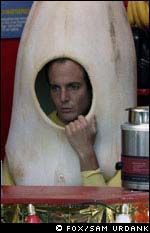
Sounds like Arrested Development was upgraded to a "Don't Buy."
Submitted by niraj
|
Click for 2 comments
The Star Tribune has an article on a 3-year old boy getting stuck in a toy claw machine at a pizza place.
The tot crawled through the toy discharge chute in the Toy Chest claw machine at a Godfather's Pizza in Austin and got stuck amid all the toys.
Fire Chief Dan Wilson said it was one of the funniest things he's ever seen. Wilson was one of three people to respond to the non-emergency call. He says the boy was inside the transparent container playing, smiling and laughing and people were taking his picture with digital cameras.
Firefighters pried the door open to get the boy out. The child wasn't hurt.
The child got stuck:

Buster was called in:

I'll save you brother!

Submitted by niraj
|
Click for 4 comments
Mon, Mar 27th, 2006 | 12:13pm | Scary
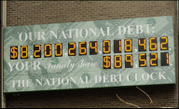
The US National Debt Clock is going to run out of digits in two years if it keeps up the current rate of increase. That's according to an AFP article on Yahoo.
The national debt clock, as it is known, is a big clock. A spot-check last week showed a readout of 8.3 trillion -- or more precisely 8,310,200,545,702 -- dollars ... and counting.
Sometime in the next two years, the total amount of US government borrowing is going to break through the 10-trillion-dollar mark and, lacking space for the extra digit such a figure would require, the clock is in danger of running itself into obsolescence. The clock's owner, real estate developer Douglas Durst, knew such a problem could arise but hadn't counted on it so soon.
"We really expected it to be quite some time," Durst told AFP. "But now, with the pace of debt growth only increasing, we're looking at maybe two years and certainly before President (George W.) Bush leaves office in 2009."
Toward the close of the millennium, with a booming economy fuelling annual budget surpluses, the clock began to slow and finally ran into its first mechanical problem.
"It wasn't designed to run backwards," Douglas Durst explained. Believing that the signboard had served its purpose, the Dursts pulled the plug in 2000 with the debt total showing around 5.7 trillion dollars and the individual "family share" standing at close to 74,000 dollars. The clock was covered with a red, white and blue curtain, but not dismantled.
He only had to wait two years as the Bush presidency coincided with an upsurge in borrowing. The curtain was raised in 2002 and the digital readout flickered back to life showing a national debt of 6.1 trillion dollars with the numerals whizzing round faster than ever.
Durst insists that the clock is non-partisan in its effort to shame the federal government over what he sees as its willingness to gamble away the nation's future. "We're a family business," Durst said. "We think generationally, and we don't want to see the next generation crippled by this burden," he said. Last week, the "family share" readout on the clock stood some loose change short of 90,000 dollars.
Submitted by niraj
|
Be the first to comment!
Currently 4.0/5 Stars, based on 1 vote
|
|